This year, the year of four new varroa control tools, also seems like a good time for a reminder: whenever you are using a treatment or practice for the first time, take the time to get familiar with the product, the application method, or how a given action fits into your operation before ploughing full steam ahead.
New mite treatments are often easiest to integrate successfully when they’re first tested on a smaller group of colonies. Even experienced beekeepers run into surprises with new products (and old products under new conditions!).
On the learning curve it’s usually best to:
- Test a subset of colonies first
- Compare results against your current standard treatment
- Avoid reaching conclusions based only on short-term observations; follow colonies over a longer period as well.
- Get comfortable with the application process (make sure you are following label instructions for your region and hive type, size, etc.)
- Evaluate mite control outcome and colony response/impacts
- Determine where the treatment fits best within your seasonal management
“How do we find the systems that work best for us while minimizing the economic costs of getting there?
Gradual integration lowers risk and gives you a chance to build confidence before scaling up.
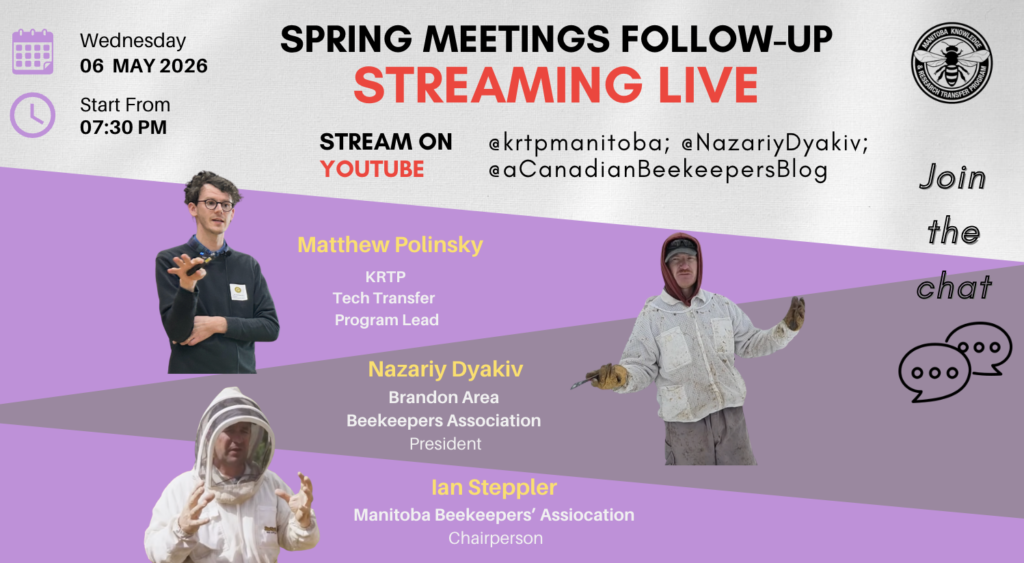
A few of the specific examples that came up during our May 6 KRTP/MBA/BABA (Manitoba Spring Meetings Follow-Up ) livestreamed chat included:
Oxalic acid glycerin (OAG) specific questions:
• Potential challenges with OAG use in the early spring (i.e. April); • Potentially harmful impacts of OAG materials not being removed before wintering;
General attentiveness to conditions across different treatment types:
• Colony status, dosage, timing for effective control, and temperature limitations (both low and high); • Potential for harsher impacts of treatments on older winter bees and the first generation of spring bees, particularly if nutritional conditions were suboptimal when they were reared
Additional considerations:
• Labour requirements and even simple handling logistics can all influence how smoothly a treatment goes – and ultimately how effective it ends up being.
…
A seasoned researcher once told me something like:
“Beekeepers tend to figure out pretty quickly whether something works or not.”
I suspect that reflects not only beekeepers’ experience, knowledge, and discerning nature, but also the scale at which they experiment – and the financial stakes involved. So my intent here is not to claim any particular wisdom, but simply to offer some food for thought on how we as beekeepers approach new things – even when they are somewhat familiar to us already. The goal is to find systems that work best for us while minimizing the economic costs of getting there.
It’s important to remember that when testing anything – whether it’s a brand-new product or simply a new timing/application strategy – you need something to compare it to. Without a comparison group, it becomes very difficult to know whether the treatment actually performed well, poorly, or no differently than your usual approach.
That said, I’m referring to the process of adapting already well-understood tools to the realities of an individual beekeeper’s system and conditions. Using the tools we have available to us now as per Health Canada and provincial regulations (2026 Manitoba Honey Bee Health Treatment Guide), I’m not referring to novel experimentation which typically requires a research authorization permit from the PRD or are conducted under the auspices of a university.
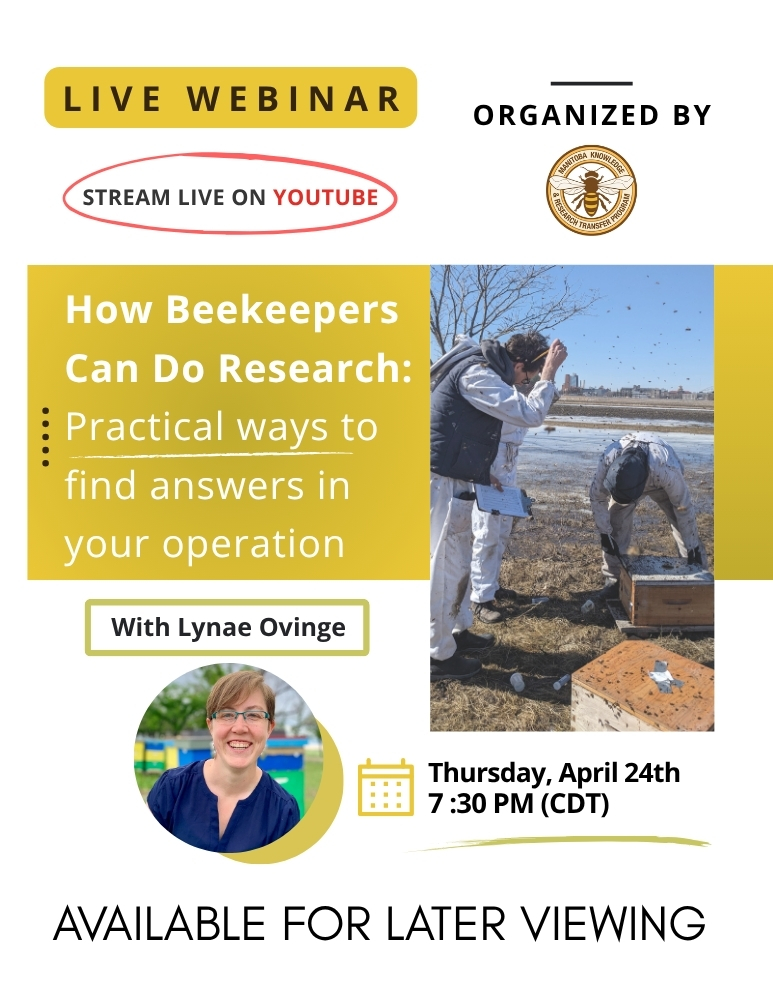
If that’s something that interests you, if you want to improve how you set up these “mini experiments”, we previously held a webinar on practical experimental design for beekeepers. It covers simple ways to organize comparisons, use control groups, and avoid common pitfalls that can make results difficult to interpret. It’s available here: “Practical Ways to Find Answers in Your Operation“
Keeping good records – they do not need to be extensive, but they should be accurate and include the right details – and comparing groups side-by-side can reveal patterns, provide answers, and make it much easier to evaluate what is and what is not working for you. A few useful things to account for during a trial may include:
- Pre- and post-treatment mite levels
- Colony strength
- Brood pattern, production
- Influence of location, i.e. “beeyard effect”
- Any signs of stress or adverse effect
But even before all those details, it’ critical the trial is set-up properly. The webinar covers how to design an experiment, including colony layout, treatment group assignment, etc.
With several new treatment options now available for your varroa management toolkit, taking a measured and informed approach today will likely save both colonies and frustration down the road.
Lastly, to paraphrase something I’ve heard the above-mentioned presenter, Lynae Ovinge, repeat over the years: I have a lot of respect for beekeeper judgement. I think part of the reason that sentiment resonates with me is that beekeeping decisions are rarely made under simple or controlled conditions. The beekeeping season arrives fast, and often we’re making five decisions at once in reacting to weather, colony conditions, shifting bee health factors, bank accounts, and labour considerations. At every turn, we are simply trying to set colonies up with the conditions and resources they need for things to go right. Yet there are many ways things can go wrong.
This blog post is simply one small suggestion for approaching new tools and methods in a way that helps us evaluate how they fit into our own operations – hopefully with a little more confidence and fewer setbacks along the way.