
In early 2024, anecdotal reports began to emerge from beekeepers in the north-western, Russian-occupied Abkhazia region of Georgia which suggested the presence of Tropilaelaps. However, the political situation made these reports difficult to verify. It was not until the summer of 2024, when the parasite spread beyond the occupied area, that Tropilaelaps mercedesae was confirmed in two apiaries in the Samegrelo–Zemo Svaneti region (1) (see map). In June, I travelled to Georgia for the first time, where I met and worked with many beekeepers and gained first-hand insight into the unfolding Tropilaelaps situation. By spending the remainder of the year dividing my time between the UK and Georgia to conduct research, I was able to closely follow these beekeepers’ successes and failures as they adapted to managing this emerging threat.
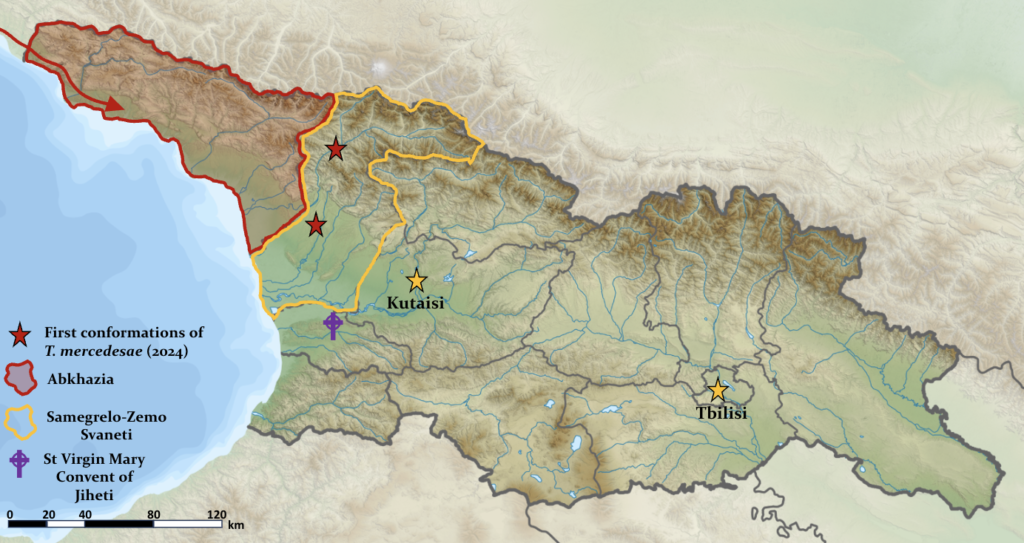
Map of Georgia showing entry of Tropilaelaps mercedesae (red arrow) in 2024 and detection.
Two of my favourite beekeepers must be Daniella and Natalie, who are nuns at the Saint Virgin Mary Convent of Jiheti, which is nestled in the foothills of the lesser Caucasus mountains near the village of Nigoiti. Twelve years ago, Natalie found three abandoned, but inhabited, hives in the convent grounds while cutting the grass, and took it upon herself to care for them. Initially local beekeepers offered help and advice, but Natalie, who clearly has a natural aptitude for beekeeping, soon began to question the logic of some of this advice and learnt the art of beekeeping through careful observation of the bees. Six years later Daniella joined the convent and began to help Natalie with the beekeeping. Together they have grown the apiary to 86 colonies and they are now the ones that local beekeepers come to for advice. Many beekeepers in Georgia will move their colonies at some point in the season, either between established apiaries or to migratory apiary sites. As nuns, Daniella and Natalie maintain a closed apiary and do not collect swarms, and as the convent is relatively secluded their circumstances give an interesting insight into Tropilaelaps transmission and reproduction. Both are also meticulous record keepers, and on my last visit to the convent I learned that Daniella had been a biologist prior to taking holy orders. Their Tropilaelaps story is an interesting one.
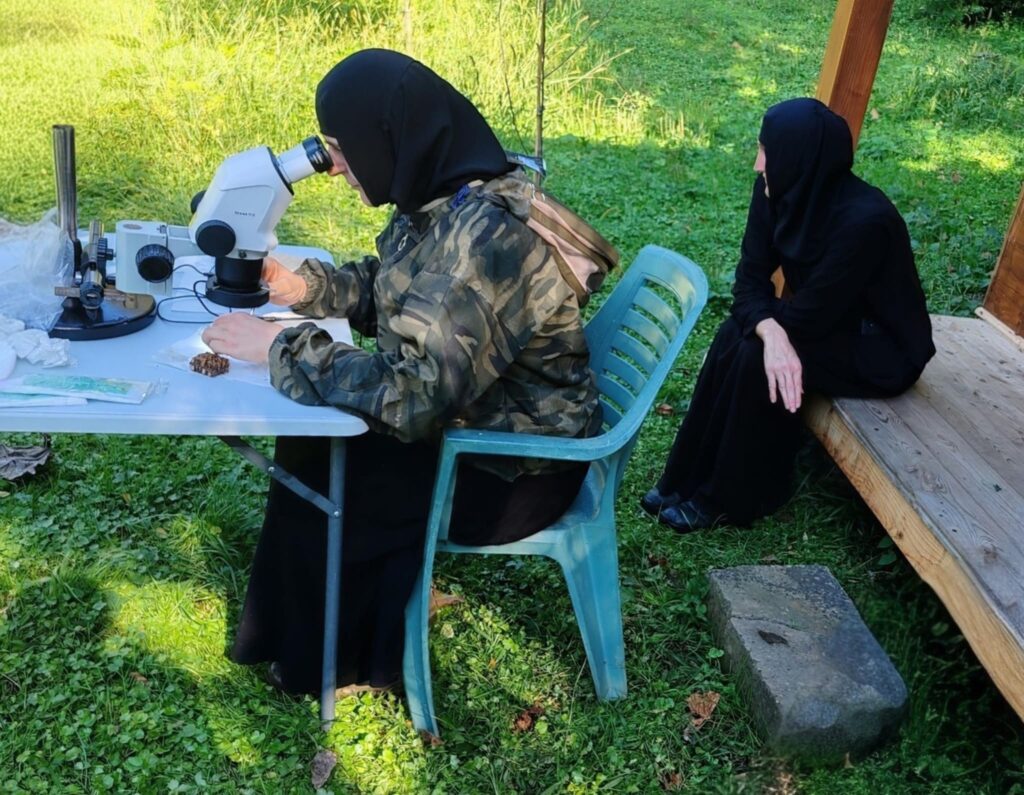
Daniella carrying out brood biopsies to assess Tropilaelaps levels.
When Tropilaelaps were confirmed in Georgia Daniella and Natalie were on the alert and began proactively checking brood every week for the presence of mites. Going into the winter of 2024 they had not discovered any Tropilaelaps in their colonies and the nearest case was approximately 20 km from the convent. As a part of their Varroa control strategy they routinely use winter queen caging. This uses a large queen cage to confine the queen and typically the queen is caged for 4 months. Natalie and Daniella begin by finding the queen and ensuring that there is still brood in the colony. They place the cage vertically, approximately 15cm from the front of the hive on a frame which contains eggs or young brood (see Fig. 1, below).
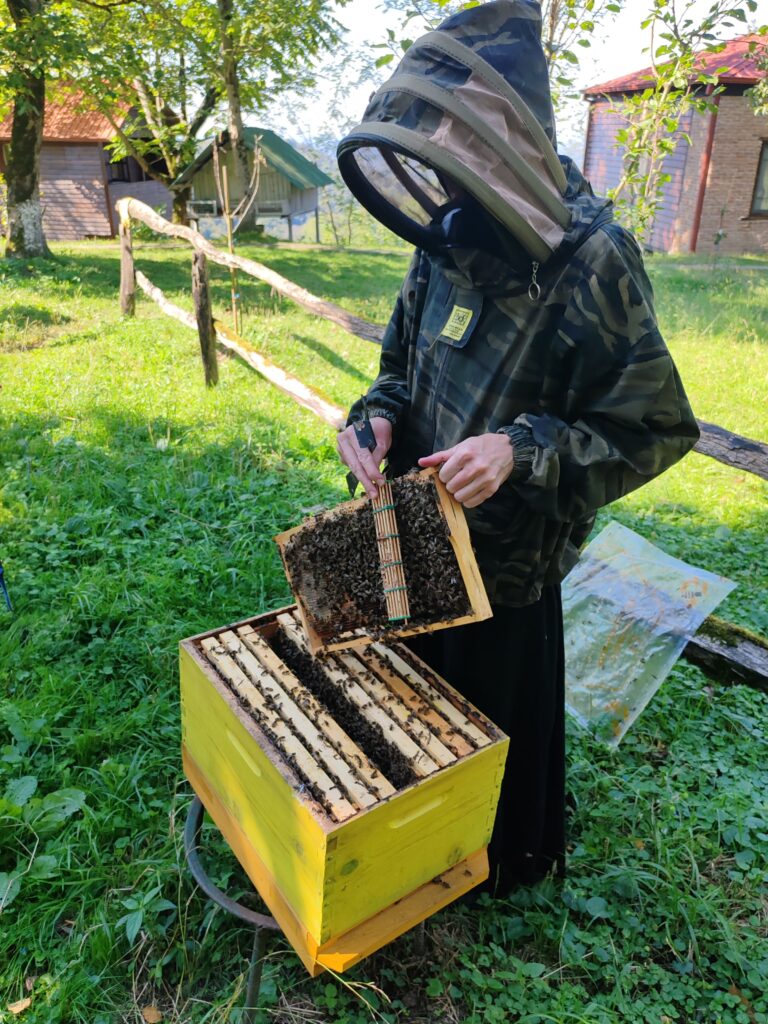
Placement of queen cage for winter queen caging (Fig.1)
The bees continue to care for this brood and therefore remain close to the queen for the longest amount of time. When the ambient temperature drops below12°C the bees form a cluster around any remaining brood, and at this point there is a risk that the queen could become isolated and die. Therefore, Natalie and Daniella continue to monitor the position of the winter cluster and its proximity to the queen cage every week and move the queen and cage into the cluster if needed. Once all the brood has emerged the winter cluster tends to remain stationary, but Natalie and Daniella continue to check the position of the cluster and the queen every two to three weeks throughout the winter. In 2024 they carried out the winter caging on the 15th of October and did not release the queens until the 13th of February. As all the colonies were broodless at this point they used oxalic acid sublimation as a treatment to control any phoretic Varroa mites. Some beekeepers were reporting winter losses as high as 80%, but the convent bees had made it through the winter with only minimal losses. When the colonies started to produce brood in the spring the Tropilaelaps monitoring resumed and in mid-March two colonies were found to have a single mite in each. No colonies had been brought into the apiary and no swarms had been collected, so Tropilaelaps could have only reached the convent on drones or foragers from other colonies in the area. However, Tropilaelaps had arrived and were present, and on their discovery Natalie and Daniella decided to treat the colonies again with oxalic acid.
I first visited the convent on the 18th of June, after having already spent around a week working with Irakli Janashia. Irakli, a lecturer at the Agricultural University of Georgia in Tbilisi, and a beekeeper of over 25 years, was the first to confirm the presence of Tropilaelaps in Georgia. Prior to the convent visit, we spent our time travelling across western Georgia to visit beekeepers who had contacted Irakli seeking help.
As we drove, Irakli seemed to receive an endless stream of calls from beekeepers. He would put these calls on speakerphone, and although I do not speak Georgian, I frequently heard the words “amitraz,” “formic,” “oxalic,” and, of course, “Tropilaelaps.” The tone of these conversations was consistently sombre. Many of the beekeepers we visited were migratory and had become infested with Tropilaelaps towards the end of 2024.
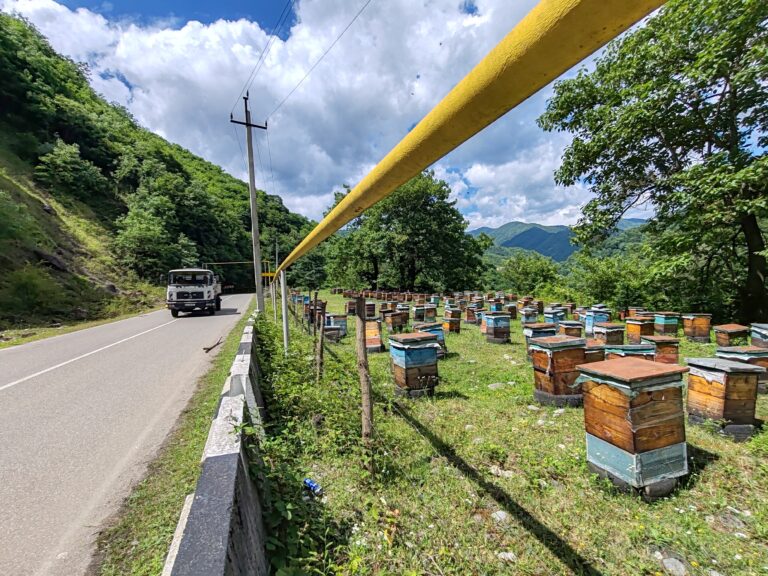
In western Georgia, migratory beekeepers overwinter their colonies in the lowlands around Kutaisi. In spring, colonies are moved up the river valleys of the Greater and Lesser Caucasus mountains, following the sequential flowering of acacia, linden, sweet chestnut, and other nectar sources, before finally reaching the high alpine meadows in August. The colonies are then returned to Kutaisi for the winter. Driving along any mountain road, it is common to see apiaries containing several hundred colonies on every accessible flat surface. This migratory pattern has almost certainly contributed to the rapid spread of Tropilaelaps across Georgia. Natalie and Daniella, however, are not migratory beekeepers.
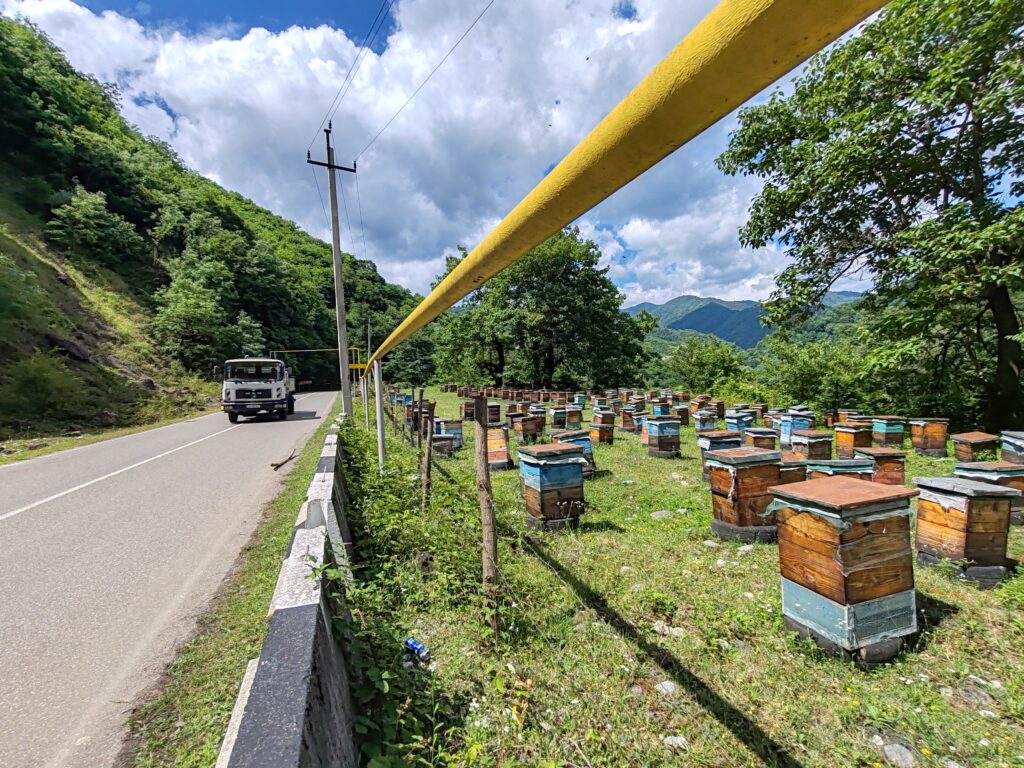
I did not know what to expect when Irakli told me we would be visiting a convent, and I felt a little nervous when he added that I should wear a dress out of respect. The drive up felt as though we were travelling back in time. We ended up on a narrow, winding mountain road, stuck behind a cattle drive of around a hundred cows and calves being moved to new pastures by nomadic cowboys on horseback. Particularly unsettling were the cattle dogs, which were larger than most of the calves and missing ears and tails; scars from fighting bears to protect the herd.
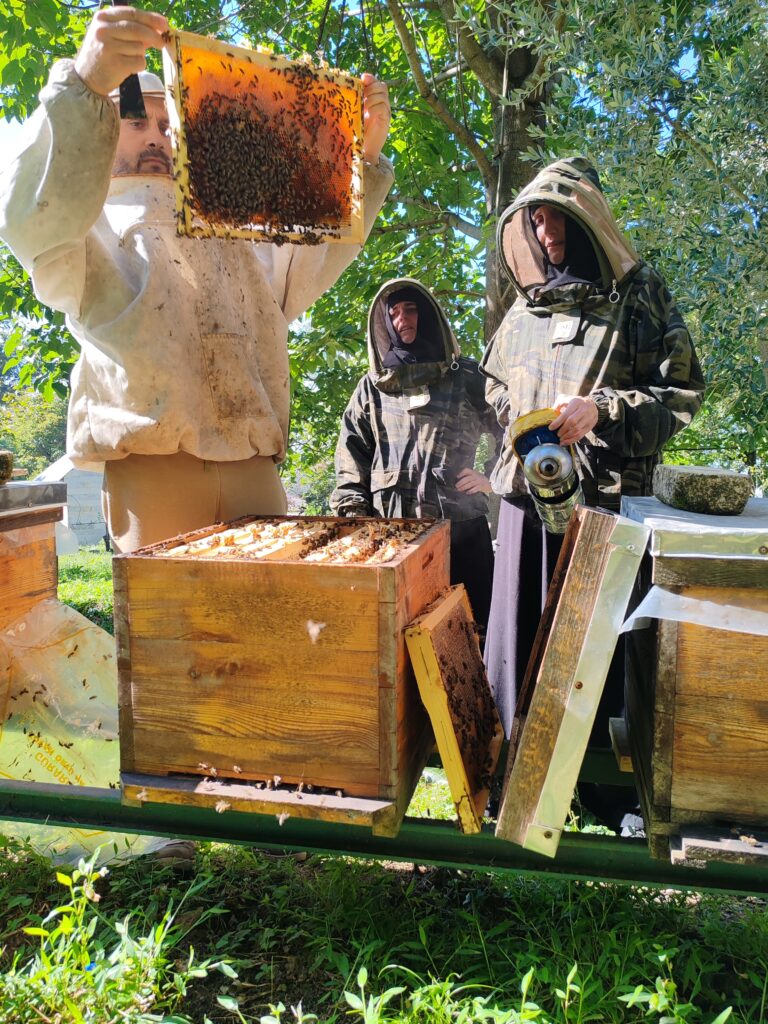
Irakli, Natalie and Daniella in the convent apiary.
The convent and church themselves are modest, and this simplicity, combined with their secluded location, may be why they survived the Russian communist occupation of Georgia. Natalie and Daniella were clearly delighted to see Irakli, though somewhat bemused by my dress. To my great relief, Natalie immediately offered me a spare pair of trousers.
Irakli has remained in regular contact with the nuns since the start of the season, and we were both keen to see the levels of infestation in the convent’s colonies. The results were variable. Some colonies showed infestation levels as low as 3%, while others were much higher, reaching around 22%.
More discouragingly, we found Tropilaelaps in every colony we examined. Natalie and Daniella explained that at this time of year they cage the queens as part of their Varroa control strategy, leaving them caged for four weeks before releasing them and treating again with oxalic acid sublimation. With 86 colonies to manage, this process usually takes the two of them around two days to complete.
The scientific literature on Tropilaelaps repeatedly states that the mite requires brood to survive, so the nuns’ plan seemed sensible. However, I could not help feeling uneasy. If my work with Tropilaelaps had taught me anything, it is that the mites clearly have not been reading the scientific literature. Our research in Thailand and Georgia had shown that Tropilaelaps can survive in swarms and persist on live and dead adult bees, as well as on dead brood, for several days; behaviours that had not previously been reported. The speed at which Tropilaelaps spread in Georgia, and the levels of infestation I had observed, were also deeply alarming and far exceeded anything I had witnessed in Thailand. I struggled to understand why this was happening. Even so, I was still shocked to receive a series of videos and messages from Irakli in early September, showing that many of the convent colonies were on the verge of collapse. The situation was desperate, and desperate times called for desperate measures. In August, we had begun developing formic acid treatments for Tropilaelaps, testing a range of delivery methods and dosages. Although the work was still at a developmental stage, we agreed that there was little to lose. As a result, Irakli, Natalie, and Daniella spent two days treating all the colonies using our new formulations. The updates that followed were encouraging, and we were able to pull the colonies back from the brink. Nevertheless, I was eager to return to Georgia to see for myself how the colonies were faring and to assess the remaining levels of infestation.
My visit in early October was largely reassuring. Once again, we spent a day examining brood under the microscope, and most showed very low levels of both Tropilaelaps and Varroa. However, two colonies stood out, with more than 30% of their brood infested with Tropilaelaps. My best explanation is that these colonies had robbed nearby colonies that were in the process of collapsing and, in doing so, had brought Tropilaelaps back with them.
These two colonies received a final formic acid treatment to kill as many mites as possible within the brood. Natalie and Daniella then brought the beekeeping season to a close by caging all queens during the first week of November. As the colonies entered winter, the situation appeared cautiously optimistic. Reaching this point, however, had required a phenomenal amount of work from Natalie and Daniella, far exceeding what a beekeeper would usually do. Many beekeepers simply do not have the time or capacity to manage Tropilaelaps so intensively, which may explain why beekeepers in Asia have often resorted to continual chemical treatments to keep mite levels manageable, unfortunately at the expense of honey quality.
References
1) Janashia I, Uzunov A, Chen C, et al. 2024. First report on Tropilaelaps mercedesae presence in Georgia: The mite is heading westward! J. Apic. Sci. 68:183–188. https://doi.org/10.2478/jas-2024-0010