I often hear from out-of-province folks: “Manitoba has a lot of beekeepers on YouTube!” And yes, we really do! So, I wanted to put together a list here to embrace our community of local communicators.
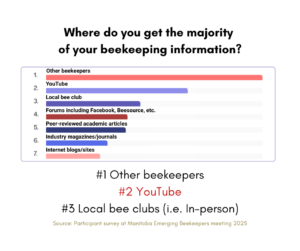
At a recent KRTP meeting with nearly 30 attendees, people of all beekeeping backgrounds shared where they get most of their beekeeping information. YouTube ranked #2. That probably isn’t surprising. Most of us have tried to figure out a home repair or learn something on YouTube.
Over the past two decades, video has become an increasingly important way we learn and share – whether for education, advocacy, or entertainment. Video blogs overtook written blogs because video is faster and easier to consume and works better with social media algorithms. Advances in smartphones and high-speed internet accelerated this shift by making recording, uploading, and watching video far easier than writing or reading a long post.
Blogs still have their place – and that’s what we aim to use here – but YouTube has become central to everything from curiosity-driven exploration to work-related learning, and beekeepers are no exception.
Some turn to YouTube for practical “how-to” guidance. Others use it to catch research presentations, webinars, interviews, and all kinds of info-tainment. The range is huge. YouTube bee content is created by hobbyists, small-scale and large commercial operators, researchers, extension specialists, retailers, and more. Some videos are polished and planned; others are raw, real, and filmed on the fly. All of them offer a window into how people think, adapt, and grow.
What does it mean that YouTube is now a common entry and meeting point for beekeeping 'know-how' and general 'api-passion'?
YouTube can be a double-edged sword. Why?
Context matters. Local environment, regulations, pests and diseases, forage, climate, access to resources, and beekeeper goals all shape management decisions. Beekeepers operating in the exact same region can approach things very differently. Just because your neighbour is doing something doesn’t necessarily mean it’s the right approach for you, your colonies, or your weather forecast – but, other perspectives still offer ideas, insights, and hints of practical know-how. Whether you want to see how a small-scale beekeeper constructs his first indoor wintering shed, get split making tips from a seasoned beekeeper, or see equipment types and construction, there’s a lot of local knowledge and historical record accumulating on YouTube channels.
Experience matters. Beekeeping YouTube shouldn’t be your only guide, nor do most content creators try to make viewers think like them or manage their colonies or businesses in the same way. Rather, it simply offers a window into ways of thinking, approaches to colony management, and business models, including the steps and challenges along the way.
Lastly, ideas and feedback from peers are not the same as systematic assessments or tried and true practices producing desired outcomes (1).
In beekeeping, nothing replaces direct, hands-on experience with bees and the local environment; in-person mentors, time invested, optimizing use of your infrastructure/resources, and learning from mistakes and seasonal variability are never-ending invaluable teachers. The perspectives we find on YouTube represent only a slice of the beekeeping possibilities in any given location.
All told, YouTube matters. As a social network, information platform, and hub for informal learning, it has an enormous influence on practices, politics, and how we connect with one another.
That said, this quote from Christine McDonald of Rushing River Apiaries in B.C. drives home how great it is to be off of internet into a room with our fellow beekeepers:
“For me, as someone who is far removed from people, getting out and going to those conferences once or twice a year is everything. It makes me sad that a lot of people are finding all of their education on YouTube nowadays, because I think that getting together in a room with like-minded people and learning together has a value that you will never get on YouTube. I still want to put my effort into making it out to those conferences, and I’m hoping that through being on the executive, I can help draw people from the online space into the in-person space.”
Below is a list of Manitoban Beekeepers on Youtube
We’re separated by vast distances and our busy bee season schedules, but these videos give a chance to see what’s happening across the province, peek inside operations, watch how weather and crops are shaping the season, and – just as importantly – connect about what’s working, what isn’t, and what we’re all still trying to figure out.
If we’re missing any, let us know!
A Canadian Beekeeper’s Blog https://www.youtube.com/@aCanadianBeekeepersBlog
Bartel Bee Co. https://www.youtube.com/@beematter/videos
Elga Apiaries TV https://www.youtube.com/@chamber_elga.apiaries
Hillside Bee Ranch https://www.youtube.com/@HillsideBeeRanch/featured
Nazariy Dyakiv https://www.youtube.com/@nazariydyakiv
Phil the BeeMan https://www.youtube.com/@philbeeman
That Bee Man at Faith Apiaries https://www.youtube.com/@ThatBeeMan
Wendell Estate Honey https://www.youtube.com/@wendellestate
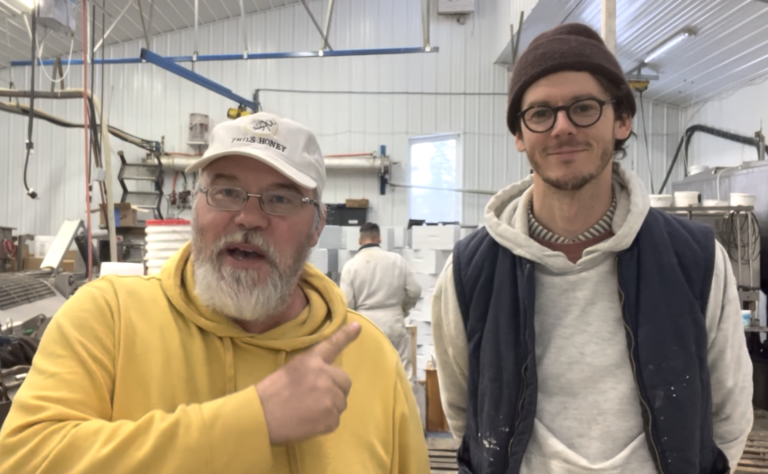
A recent KRTP YouTube appearance providing context on an ongoing experiment:
Background Discussion on an Oxalic Acid Glycerin Strips Winter Experiment
References: 1) Lange, P. G. (2018). Informal learning on YouTube. In R. Hobbs & P. Mihailidis (Eds.), The International Encyclopedia of Media Literacy (pp. 1–11). Wiley & Sons, Inc. https://doi.org/10.1002/9781118978238.ieml0090