The KRTP’s field trials are helping evaluate a promising new tool for Canadian beekeepers
There’s a new way to manage varroa mites. It’s already legal and available in the United States, and it could become a reality for Canadian beekeepers in the near future.
The Manitoba beekeeping industry has been involved in advancing RNAi field testing for varroa management since 2017, when Daryl Wright partnered with the technology’s previous developer on multi-year field trials. The KRTP has collaborated with GreenLight Biosciences from 2023-2026 as they further developed and brought this mite control option closer to the Canadian market. (It is not currently registered for use in Canada).
We recently hosted a webinar presenting field study results, including two years of the KRTP’s trials in Manitoba.
But before we get to that, what is this new treatment?
The mode of action is RNA interference (RNAi). Simply put, double-stranded RNA (dsRNA) delivered in sugar syrup is distributed throughout the colony by the bees. The dsRNA is delivered to developing brood before cells are capped, where it is later encountered by varroa and interferes with a biological process needed for the mites’ successful reproduction.
Briefly: dsRNA in syrup → Nurse bees distribute it → Developing brood → Mites enter cells → Reproduction is disrupted
Two excellent primers on how the treatment works include:
- The North Central IPM Center RNAi & Varroa: A New Technology for Managing an Old Pest of the Honey Bees.
- Texas A&M Apiculture Extension Program: Norroa: A novel approach to varroa mite control
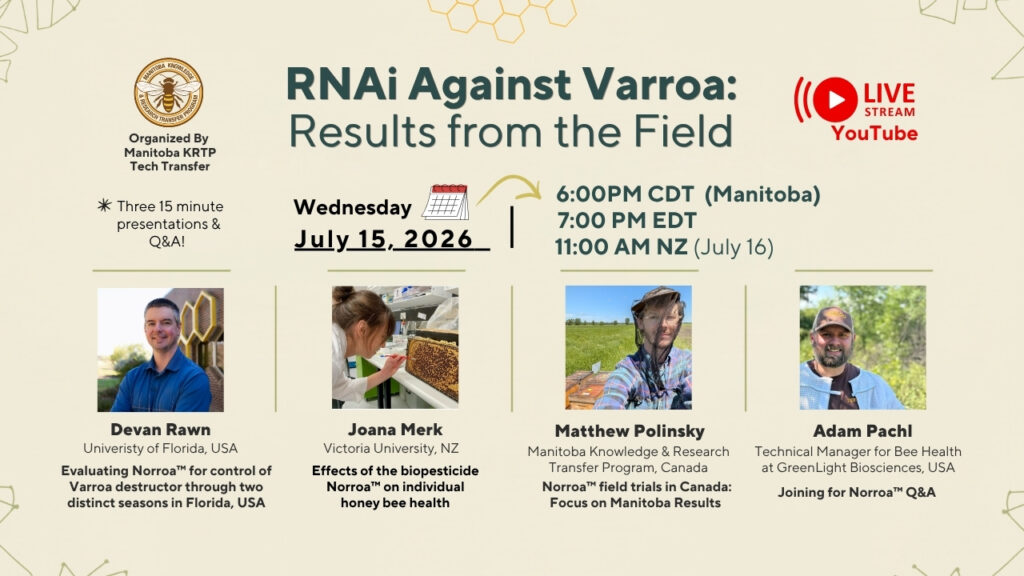
In our recent webinar, RNAi Against Varroa: Results From the Field, three presenters shared field trial results, and GreenLight Biosciences representatives joined to answer questions.
Devan Rawn from the University of Florida presented results from trials conducted during two distinct seasons, notably, one conducted during a dearth period and the other during a moderate nectar flow.
Joana Merk from Victoria University of Wellington, New Zealand, tracked individual honey bee longevity and foraging activity using RFID tags.
Lastly, Matthew Polinsky presented two years of results from field trials conducted by the KRTP in Manitoba.
The KRTP has worked with industry partners to conduct these field trials, generate efficacy and safety data, and communicate the results to beekeepers. We’ve shared these findings at conferences for the past three years, and now they’re available online.
An added benefit for Manitoba beekeepers is that these locally conducted trials have provided years of firsthand experience with the treatment under Manitoba conditions. If it is registered in Canada and adopted by beekeepers, the KRTP will be well positioned to help shorten the learning curve and reduce economic risk as it is integrated into varroa management programs.
Various publications on RNAi for managing Varroa (the two studies presented in our webinar are in bold):
Bortolin, F., Rigato, E., Perandin, S. et al. First evidence of the effectiveness of a field application of RNAi technology in reducing infestation of the mite Varroa destructor in the western honey bee (Apis mellifera). Parasites Vectors 18, 28 (2025). https://doi.org/10.1186/s13071-025-06673-7
Garbian Y, Maori E, Kalev H, Shafir S, Sela I. Bidirectional transfer of RNAi between honey bee and Varroa destructor: Varroa gene silencing reduces Varroa population. PLoS Pathog. 2012 Dec;8(12):e1003035. doi: 10.1371/journal.ppat.1003035. Epub 2012 Dec 20.
McGruddy R, Haywood J, Lester PJ. Beekeepers Support the Use of RNA Interference (RNAi) to Control Varroa destructor. Insects. 2024 Jul 18;15(7):539. doi: 10.3390/insects15070539
McGruddy, R. A., Felden, A., Baty, J. W., Manley, B., Masucci, J. D., Haywood, J., & Lester, P. J. (2026). RNAi can be effective for the control of Varroa destructor in honey bee colonies. Journal of Apicultural Research, 1–15. https://doi.org/10.1080/00218839.2026.2622814
Merk, J., Anastasi, M., McGruddy, R. et al. Longevity and foraging performance of honey bees treated with an RNAi-based Varroa destructor biopesticide. Sci Rep 16, 8208 (2026). https://doi.org/10.1038/s41598-026-38557-w
Merk J, Felden A, Baty J, and Lester P. Novel RNA interference–based biopesticide targets for neural, reproductive and metabolic pathways, inducing mortality and transcriptomic disruption in Varroa destructor. Available at SSRN: https://ssrn.com/abstract=6755378 or http://dx.doi.org/10.2139/ssrn.6755378
Lester PJ, Bulgarella M, Manley B, Masucci JD, McGruddy RA, Merk J, Narva K, Palmer S, Mercier OR and Smeele Z (2026) Norroa™ as a dsRNA biopesticide for Varroa destructor: insights from New Zealand research on mode of action, field efficacy, non−target effects, and social acceptance. Front. Insect Sci. 6:1814622. doi: 10.3389/finsc.2026.1814622
Rawn D, Prouty C, Gautam A, Jamison M, Talton W, Youngs K, Narva K, Manley B and Jack C (2026) Evaluating the new product Norroa™ against Varroa destructor in managed honey bee (Apis mellifera) colonies. Front. Insect Sci. 6:1751606. doi: 10.3389/finsc.2026.1751606
Smeele, Z.E., McGruddy, R.A., Baty, J.W., Manley, B., Narva, K., De Neef, E., Gordon, E.R., Devisetty, U.K., Youngs, K., Felden, A. and Lester, P.J. (2026), An RNA interference biopesticide reduces reproduction of the honey bee parasite Varroa destructor by down-regulating embryo development pathways. Pest Manag Sci, 82: 2694-2707. https://doi.org/10.1002/ps.70406